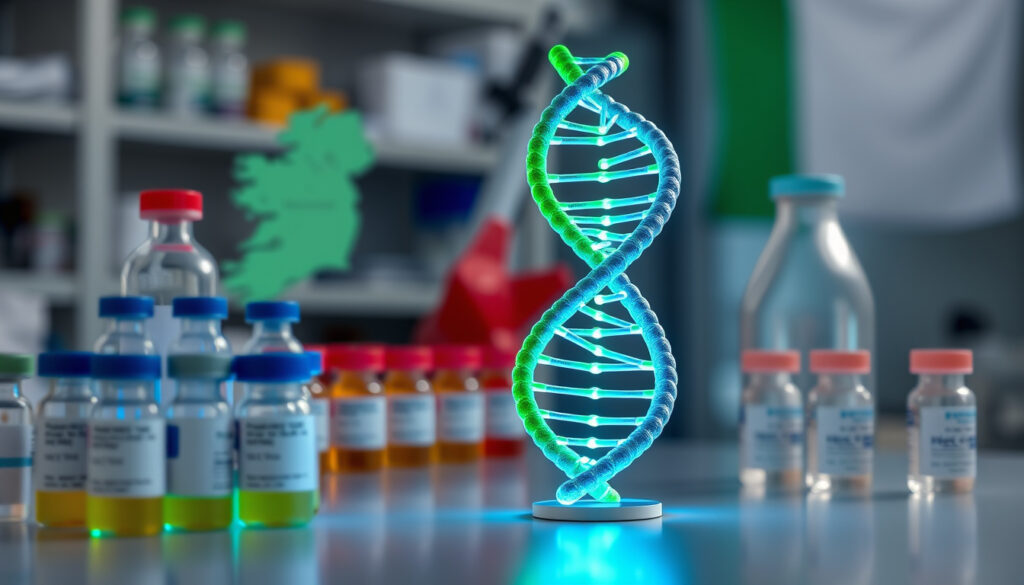
DNA Testing in Ireland: Accuracy, Cost & Best Providers
There’s a moment when a DNA test stops being a curiosity and becomes a decision — whether it’s confirming paternity, uncovering your ancestry, or checking for a hereditary condition. For anyone in Ireland weighing up the options, the choice between a €119 home kit and a full legal test can feel surprisingly complicated.
Accuracy of accredited paternity tests: 99.99% · Typical cost in Ireland: €119–€179 · Common turnaround time: 3–5 working days · At-home paternity tests ordered in Ireland: over 70%
Quick snapshot
- Accredited labs achieve 99.99% accuracy for paternity tests (AlphaBiolabs Ireland — ISO 17025-accredited lab)
- Legal DNA tests require witnessed chain-of-custody (AlphaBiolabs Ireland — paternity testing guide)
- Home kits are for peace of mind only — not court-admissible (AlphaBiolabs Ireland — paternity testing guide)
- Long-term privacy risks of commercial DNA databases remain unregulated in Ireland
- Future regulation of direct-to-consumer health tests is uncertain
- AlphaBiolabs established in August 2004 (AlphaBiolabs Ireland — Dublin testing services)
- Genetrack Ireland offers results in 1–2 business days (Genetrack Ireland — paternity testing)
- Demand for combined health-and-ancestry panels is growing
- Legal admissibility standards may tighten as home testing rises
| Metric | Value |
|---|---|
| Accuracy of accredited paternity test | 99.99% |
| Average cost in Ireland | €149 |
| Turnaround time | 3–5 working days |
| Legal admissibility | Only with chain-of-custody |
| Most common type ordered | Paternity test |
How accurate is a DNA test?
Accredited labs that follow ISO 17025 standards report 99.99% accuracy for paternity tests. That figure comes from analyzing 16 to 21 genetic markers — when every marker matches, the probability of paternity exceeds 99.99%. When multiple markers exclude the alleged father, the result is just as definitive: the man is not the biological father. AlphaBiolabs Ireland — ISO 17025-accredited lab and EasyDNA Ireland — ISO 17025-accredited provider both operate under this standard.
What does a 99.99% accuracy mean in paternity testing?
The 0.01% residual uncertainty is not a flaw — it’s mathematical caution. In theory, two unrelated individuals could share enough markers to produce a false match, though the odds are extraordinarily low. AlphaBiolabs Ireland — paternity testing guide notes that false negatives are virtually nonexistent when samples are collected properly. The real vulnerability is at-home kits where the person providing the sample isn’t witnessed — poor collection or deliberate substitution can undermine accuracy regardless of the lab’s certification.
A 99.99% lab result means nothing if the sample was collected in your kitchen without a witness. Home-test buyers: your accuracy ceiling is set at the moment you hand over the swab, not when the lab processes it.
The implication: for legal proceedings, only a witnessed collection backed by chain-of-custody turns that 99.99% accuracy into something a court will accept. For peace of mind, a home kit from an accredited lab is plenty reliable — just don’t expect it to hold up in a family law hearing.
What can be detected in a DNA test?
DNA tests fall into three broad categories, each answering a different question. Paternity tests compare genetic markers between a child and alleged father. Ancestry tests map your geographic origins. Health tests scan for mutations linked to specific diseases. Genetrack Ireland — AABB & ISO 17025-accredited lab offers tests across all three categories from its accredited facility.
What diseases can DNA testing tell you?
Health-focused genetic tests can identify carrier status for conditions like cystic fibrosis, sickle cell anemia, and Tay-Sachs disease. They can also predict elevated risk for hereditary cancers, particularly breast and ovarian cancer linked to BRCA1 and BRCA2 mutations. Genetrack Ireland — accredited testing lab offers health panels that screen for these markers, though results typically require a doctor’s interpretation.
What are the three diseases that can be predicted by genetic testing?
Three well-documented hereditary conditions with clear predictive markers are:
- Huntington’s disease — a single-gene disorder with near-complete penetrance
- Cystic fibrosis — carrier screening identifies mutations before symptoms appear
- BRCA-related hereditary breast and ovarian cancer — elevated risk detectable via specific gene variants
Genetrack Ireland — accredited health testing lab notes that predictive testing for these conditions gives patients the option of early monitoring or preventive measures, though it also raises the question of what you do with information you can’t unlearn.
A positive result for a hereditary condition doesn’t guarantee you’ll develop it — but it shifts your relationship with your health from reactive to proactive. For Irish patients, the challenge is finding a genetics counselor to walk you through what a raw result actually means.
The trade-off: disease detection tests offer powerful foresight, but the regulatory framework for direct-to-consumer health tests in Ireland remains unclear. No official body currently audits the clinical claims of home health DNA kits, so a result from a non-accredited provider should be treated as informational — not diagnostic.
How much does a typical DNA test cost?
Across Ireland’s main providers, prices cluster into three bands: peace-of-mind paternity tests from €119 to €240, legal paternity tests from €119 to €395, and ancestry tests from €79 to €199. The gap between home and legal pricing reflects the overhead of chain-of-custody procedures, witnessed collection, and court-ready documentation. AlphaBiolabs Ireland — DNA testing pricing lists its legal test from €119, while Treoir — Irish paternity information service records legal tests through Alpha Biolaboratories at €395 — highlighting how the exact scope of service (court preparation, additional alleged fathers, expedited turnaround) can double the headline price.
Is a home paternity test cheaper than a legal test?
Yes — and the gap is roughly €80 to €200. AlphaBiolabs Ireland — home paternity testing guide markets its home kit at €119, its legal test starting from €119 but rising with chain-of-custody add-ons. Treoir — paternity testing providers Ireland lists a peace-of-mind test at Chemical Analysis Laboratory in Sandycove for €240 and a legal test at Alpha Biolaboratories in Dublin 2 for €395. You’re not paying for better lab work — you’re paying for the paper trail that makes the result count in court.
Four providers, one pattern: home tests are cheaper upfront, legal tests cost more but hold binding value.
| Provider | Home test price | Legal test price | Accreditation |
|---|---|---|---|
| AlphaBiolabs Ireland | €119 | €119+ | ISO 17025 |
| EasyDNA Ireland | €169 | €169+ | ISO 17025 |
| Chemical Analysis Laboratory (Sandycove) | €240 | Not listed | ISO 17025 |
| Alpha Biolaboratories (Dublin 2) | €190 | €395 | ISO 17025 |
Treoir — Irish paternity information service reports that additional alleged fathers cost €120 at Chemical Analysis Laboratory, making multi-person tests a significant cost consideration for families.
The catch: the cheapest legal test starts at €119, but by the time you add witnessed collection, documentation, and potentially a second alleged father, you’re closer to €300. Budget for the all-in price, not the headline.
Are DNA tests worth it?
For most people, yes — but the value depends entirely on your goal. Paternity tests deliver closure or legal certainty. Ancestry tests satisfy curiosity. Health tests offer actionable medical insight. AlphaBiolabs Ireland — paternity testing guide frames it plainly: if you need an answer for yourself, a home kit is sufficient. If you need an answer for a solicitor, only a legal test will do.
What is the downside of DNA testing?
- Privacy concerns — commercial DNA databases may share anonymized data with third parties; long-term Irish regulation is absent
- Emotional fallout — unexpected paternity exclusions or discovery of half-siblings can destabilize families
- False negatives from poor samples — home kits rely on the user collecting a clean swab; contamination yields inconclusive results
- Cost — legal tests and multi-panel health screens can run past €400
What does DNA say if a father is not that of a child?
When a child’s DNA profile includes markers that the alleged father does not carry, the lab reports an exclusion at those loci. In a standard 21-marker test, three or more exclusions mean the man is definitively not the biological father. AlphaBiolabs Ireland — legal paternity testing states that the probability of paternity in an exclusion case is zero. The report typically shows the specific markers excluded, so both parties can see the science behind the answer.
DNA testing gives you certainty, but that certainty sometimes arrives as a shock. Irish family law cases built on home test results collapse because the sample wasn’t witnessed. The most accurate test in the world is useless if the chain of custody was broken at step one.
What this means: if you suspect paternity is in question, order a home test from an accredited lab first to know the truth yourself. If the result changes legal obligations, then invest in the full legal test with witnessed collection. Don’t do it in reverse — you can’t unlearn a result, and you can’t retroactively fix a missing witness signature.
Who is the most accurate DNA test?
No single provider is categorically more accurate than another — the accuracy ceiling is set by the lab’s accreditation, not the brand. Any ISO 17025-accredited lab operating in Ireland (AlphaBiolabs, EasyDNA, Genetrack, Chemical Analysis Laboratory, Dr. Stephen Murphy) can deliver 99.99% accurate paternity results. Genetrack Ireland — AABB & ISO 17025-accredited lab also holds CLIA accreditation, while AlphaBiolabs Ireland — Dublin testing services lists accreditation number 2773.
Which DNA test is best for paternity in Ireland?
For most Irish residents, the best choice depends on two factors: turnaround time and whether the test needs to be court-admissible. Genetrack Ireland — paternity test page advertises results in 1–2 business days — the fastest among major providers. AlphaBiolabs and EasyDNA quote 3–5 working days. If you need legal admissibility, confirm the provider offers witnessed collection and chain-of-custody documentation; Treoir — Irish paternity information service lists Alpha Biolaboratories in Dublin 2 and Chemical Analysis Laboratory in Sandycove as approved for legal testing.
If you need an answer by Friday, Genetrack is your fastest option. If you need an answer a judge will accept, pick any ISO 17025-accredited lab that offers witnessed collection. If you just want to know before your next family dinner, save money with a home kit — but understand what you’re giving up.
The pattern: speed and accreditation are not the same thing. Genetrack’s 1–2 day turnaround comes from a lab with over 25 years of experience — it’s both fast and accredited. AlphaBiolabs’ €119 legal test includes chain-of-custody but takes longer. For the Irish market, the trade-off is days versus documentation.
Pros and cons of DNA testing
Upsides
- 99.99% accurate with accredited labs
- Peace of mind within 3–5 days
- Can detect hereditary disease risk early
- Ancestry tests reveal geographic origins
- Legal tests are court-admissible
Downsides
- Unregulated data privacy for commercial DNA databases
- Emotional impact of unexpected results
- Home kits not valid for legal proceedings
- Cost of legal tests can exceed €400
- Health tests require doctor interpretation
How to choose the right DNA test in Ireland
- Step 1: Define your goal. Ask yourself one question: do I need this result for a court case, or for my own knowledge? If it’s for child support, custody, or inheritance disputes, skip the home kit entirely and go straight to a lab offering witnessed collection and chain-of-custody. AlphaBiolabs Ireland — legal paternity testing makes the process explicit: you attend an appointment, provide ID, and the sample is documented from collection to analysis.
- Step 2: Check accreditation. Look for ISO 17025 accreditation on the provider’s website. EasyDNA Ireland — accreditation statement states all samples are analyzed in ISO 17025-accredited labs. Genetrack Ireland — accreditation information holds AABB, ISO 17025, and CLIA certification. If a provider doesn’t display its accreditation number, treat that as a red flag.
- Step 3: Compare total cost. Home paternity tests in Ireland range from €119 to €240. Legal tests range from €119 to €395 — but the lower end often doesn’t include the witnessing fee or additional alleged fathers. Treoir — paternity testing pricing Ireland notes that extra alleged fathers at Chemical Analysis Laboratory cost €120 each. Get a full written quote before you order.
- Step 4: Consider turnaround. If you need results urgently, Genetrack Ireland — turnaround time advertises 1–2 business days. Most other providers take 3–5 working days. Standard turnaround times don’t include weekends or bank holidays, so factor that in if you’re timing for a court date.
- Step 5: Understand what you’re not getting. A home DNA kit will tell you if a man is the biological father of a child. It will not tell you anything about ancestry, disease risk, or legal paternity in the eyes of the court. AlphaBiolabs Ireland — home paternity testing guide is clear: these are peace-of-mind products. If you want ancestry or health data, you need a separate test panel from a provider that offers it.
For Irish readers with a specific health concern, the fastest path is a combined paternity-and-health panel from an accredited lab. For ancestry, services like AncestryDNA or 23andMe ship internationally, but their results carry no legal weight and their data storage practices operate outside Irish jurisdiction.
“Our legal paternity tests are ISO 17025 accredited and follow strict chain-of-custody procedures, ensuring the result is admissible in Irish courts. Results are typically available within 3–5 working days.”
— AlphaBiolabs Ireland representative, discussing standard turnaround and court admissibility (AlphaBiolabs Ireland)
“We’ve been operating our laboratory for over 25 years, and our paternity tests are processed at our AABB, ISO 17025, and CLIA accredited facility. Results are ready in 1 to 2 business days.”
— Genetrack Ireland customer support, describing lab credentials and speed (Genetrack Ireland)
For anyone in Ireland shopping for a DNA test, the decision isn’t about which brand is best — it’s about what kind of answer you actually need. A home kit from an accredited lab gives you the truth. A legal test from the same lab makes that truth count. And if you’re testing for disease risk, remember: a lab report is not a diagnosis — it’s a signal that deserves a conversation with your GP.
alphabiolabs.ie, briefingroom.uk, briefingroom.uk, solo.ie, alphabiolabs.ie, ibdna.ie
Frequently asked questions
Can a DNA test be done without the mother’s sample?
Yes. Paternity tests can compare the child’s DNA directly against the alleged father’s sample. Adding the mother’s sample increases statistical certainty, but it’s not required. AlphaBiolabs Ireland — testing options offers tests with or without the mother’s participation.
How long do DNA test results last?
DNA itself is stable for years if stored correctly, but labs typically retain samples for 6 to 12 months. The report you receive is a permanent record — keep a digital and physical copy. Genetrack Ireland — sample retention policy notes that samples may be destroyed after the test is completed unless you request extended storage.
Is a home DNA test legal for child support cases?
No. Irish courts require DNA evidence with a documented chain of custody. A home test collected without a witness cannot be used as evidence in child support, custody, or inheritance proceedings. AlphaBiolabs Ireland — home testing guide explicitly warns that home kits are for peace of mind only.
What is the difference between a paternity test and a DNA fingerprint test?
Paternity tests compare specific genetic markers between two or three individuals to determine biological relationships. DNA fingerprinting (profiling) creates a unique genetic profile of a single individual and is used in forensic identification. Both analyze DNA, but the question they answer is different: “Who is the father?” versus “Whose DNA is this?”
Can I get a DNA test on the NHS in Northern Ireland?
In Northern Ireland, NHS genetic testing is available only when there’s a clinical need — typically for diagnosing rare diseases or confirming carrier status. Paternity testing is not provided by the NHS. Private labs in Belfast and across the border in Dublin handle the vast majority of paternity cases. Treoir — cross-border paternity information offers guidance for families in Northern Ireland seeking private testing.
Are DNA tests covered by health insurance in Ireland?
Not typically. Irish health insurers like VHI and Laya do not cover paternity or ancestry DNA tests. Some genetic health screening (for BRCA or hereditary conditions) may be covered if a GP refers you based on family history. Direct-to-consumer health kits are almost always out-of-pocket expenses.
More related posts
 Liv Morgan: WWE Career, Husband, Kids, Injury & Return
 Love Island Season 12 – Premiere Date Cast Location
 Sheridan Smith: Biography, Partner, Diagnosis, Children
 Verify Identity Companies House: GOV.UK Guide & ACSP Steps
 Mike Smith (Broadcaster): Death, Career & Sarah Greene
 This City Is Ours Season 2 – Release Date, Cast and BBC Details
 Jo Good: Age, Career, Only Fools Role & Relationship Status
 Type 2 Diabetes Treatment – NICE 2026 Guidelines