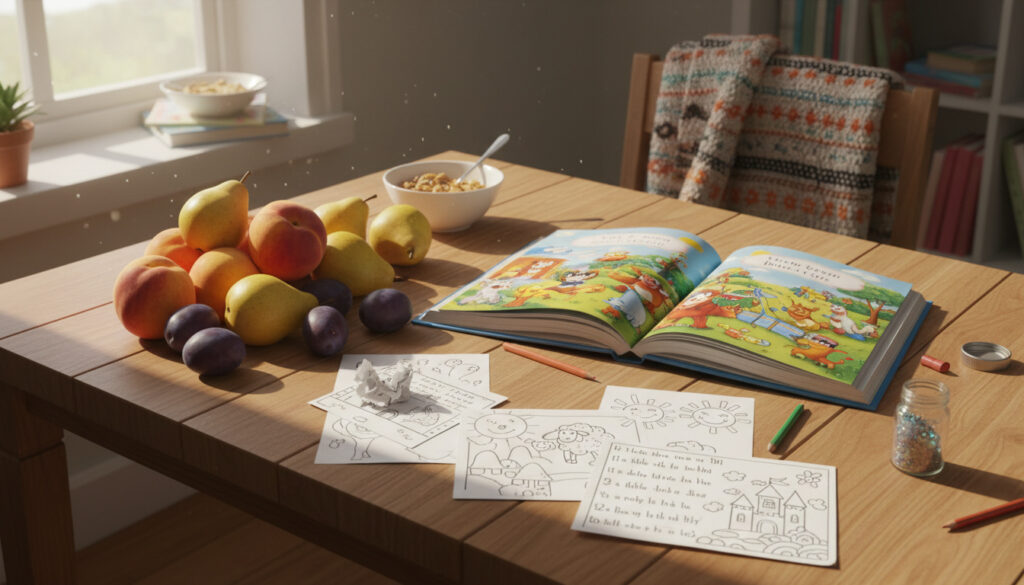
Each Peach Pear Plum – Summary, Lyrics, Authors & Activities
Each Peach Pear Plum stands as a foundational work in children’s literature, first published in 1978 by Puffin Books. Created by the husband-and-wife team of Allan Ahlberg and Janet Ahlberg, the picture book integrates rhythmic verse with visual puzzle elements, inviting young readers to locate hidden nursery rhyme characters within meticulously rendered English countryside vignettes.
The narrative operates as an extended “I Spy” game, progressing through rhythmic couplets that introduce figures from traditional English folklore. According to The Spinoff, the book has sold over six million copies since its release and maintains its position as a staple of early childhood reading collections.
Janet Ahlberg’s watercolor-and-ink illustrations earned the work the Kate Greenaway Medal in 1979, recognizing excellence in children’s book illustration and cementing its status within the literary canon.
What is Each Peach Pear Plum?
- Interactive spotting game featuring iconic nursery rhyme characters
- Winner of the 1979 Kate Greenaway Medal for illustration
- Circular narrative structure culminating in communal celebration
- Develops observational skills and predictive reading abilities
- Employs rhythmic couplets optimized for bedtime reading
- Sold over six million copies across multiple editions
| Authors | Allan Ahlberg (text), Janet Ahlberg (illustrations) |
|---|---|
| Publisher | Puffin Books (Penguin imprint) |
| First Published | 1978 |
| US Edition | October 7, 1986 |
| Length | 32 pages |
| Format | Hardcover, paperback, board book |
| Awards | Kate Greenaway Medal (1979), Carnegie Medal for Illustration |
| ISBN | 978-0140505090 |
Who Wrote Each Peach Pear Plum?
The Creative Partnership
Allan Ahlberg and Janet Ahlberg formed a prolific creative partnership spanning from 1975 until Janet’s death in 1994. Working from their English home, the couple produced a distinct body of work characterized by intricate integration of text and image. Allan crafted the rhythmic verses while Janet executed detailed watercolor-and-ink illustrations featuring William Morris-style patterns, bucolic landscapes, and hidden visual elements.
Their bibliography includes other acclaimed titles such as The Jolly Christmas Postman, which also received the Kate Greenaway Medal. Allan Ahlberg continued writing until his death on July 29, 2025, leaving a legacy that fundamentally shaped modern picture book design.
Publication History
Puffin Books released the first edition in the United Kingdom in 1978. The work subsequently appeared in the United States through Penguin Random House on October 7, 1986. Later printings introduced board book formats designed to withstand toddler handling, with current paperback editions retailing for approximately $8.99.
The book won the Kate Greenaway Medal in 1979 specifically for Janet Ahlberg’s illustrations. This honor, awarded by the Chartered Institute of Library and Information Professionals, recognized the work’s exceptional artistic contribution to children’s literature.
What Are the Lyrics of Each Peach Pear Plum?
Rhyme Structure and Meter
The text utilizes rhythmic couplets with consistent meter designed for oral reading. The narrative opens with the lines: “Each peach pear plum / I spy Tom Thumb.” This pattern continues throughout the 32 pages, maintaining a musical quality that Stories That Stay With Us notes is particularly effective for bedtime rituals.
The structure follows a circular trajectory, concluding with the couplet: “Plum pie in the sun / I spy … EVERYONE!” This final reveal unites all previously introduced characters in a communal picnic scene, providing narrative closure through shared celebration.
The Character Chain
The narrative progresses through a sequential “tag” format where each character spots the next:
- Tom Thumb (hidden in the plum tree)
- Mother Hubbard (in her cottage with raspberry jam)
- Three Bears (equipped with hunting rifles)
- Baby Bunting (floating in a Moses basket)
- Bo Peep (with her sheep)
- Jack and Jill (tumbling)
- Robin Hood
- Wicked Witch (who joins the final picnic)
As documented by Victoria’s Library, the Wicked Witch undergoes a narrative redemption, transitioning from potential antagonist to picnic participant.
The artwork features detailed watercolor-and-ink compositions depicting cozy cottages, fruit-laden vines, and blue summer skies. Readers must examine each panel carefully to locate the hidden figures, which appear partially obscured by foliage, furniture, or architectural elements.
Each Peach Pear Plum Activities for Children
Interactive Reading Games
Parents and educators extend the book’s I Spy format into physical activities. The Baby Librarians blog recommends taking the spotting game outdoors, encouraging children to locate specific colors or objects in garden or park settings after reading the book indoors.
Rhythm exercises accompany the text effectively. Children clap or tap fingers to maintain the beat while reciting the couplets, reinforcing phonological awareness through physical movement.
Creative Extensions
The character chain lends itself to dramatic play. Children act out the “tag” sequence, assuming roles of the various nursery rhyme figures. Drawing activities encourage completion of missing scenes, such as illustrating the woods between locations or designing additional picnic guests.
Craft projects inspired by Stories That Stay With Us include constructing plum pie props from paper plates or creating homemade spy books mimicking the vine-and-fruit motifs found in the endpapers.
Educational Recognition
Beyond the Kate Greenaway Medal, the book received the Carnegie Medal for Illustration. Educational assessments emphasize its value for pre-literacy development, teaching children to predict narrative sequences and recognize recurring visual patterns before they master textual decoding.
While publishers designate the book for ages 0–3, the intricate hidden illustrations engage preschoolers up to age 5. Parent reviews consistently note the text’s durability for repeated readings without inducing adult fatigue, making it suitable for nightly bedtime routines.
How Did Each Peach Pear Plum Evolve Over Time?
- : First published by Puffin Books in the United Kingdom.
- : Awarded the Kate Greenaway Medal for Janet Ahlberg’s illustrations.
- : United States edition released by Penguin Random House on October 7.
- : Board book editions introduced to accommodate toddler handling and durability requirements.
- : Allan Ahlberg dies on July 29, concluding the creative partnership’s posthumous influence on the title.
What Facts Are Definitively Established?
| Established Information | Uncertain or Misconceptions |
|---|---|
| Created by Allan Ahlberg (text) and Janet Ahlberg (illustrations) | Not a traditional nursery rhyme song, but an original literary composition |
| Won the Kate Greenaway Medal in 1979 for illustration excellence | No film, television, or theatrical adaptations have been officially produced |
| Contains 32 pages of seek-and-find panels | Video readings available online are unofficial recordings, not licensed adaptations |
| Recommended for children aged 0–3 years by publishers | Specific sales figures beyond “over six million” remain unverified by independent auditors |
What Makes Each Peach Pear Plum Distinctive?
The book distinguishes itself from generic I Spy formats through its narrative coherence. While traditional spotting books present static object hunts, the Ahlbergs created a linked progression where each page turn advances a story. This structure, analyzed by Goodreads reviewers, generates predictive engagement as children anticipate which character will appear next in the chain.
Aesthetic elements draw from English Arts and Crafts traditions, with William Morris-inspired patterns adorning textiles and wallpapers within the illustrations. The color palette emphasizes summer greens, plum purples, and sky blues, creating a nostalgic vision of rural England that transcends specific time periods.
The work occupies a unique position between folklore preservation and original creation. By importing established characters like Cast of Labyrinth 1986 Tom Thumb and Robin Hood into a new narrative framework, the book introduces young readers to cultural touchstones while providing fresh context for their interactions.
What Do Critics and Parents Say?
“Each peach pear plum, I spy Tom Thumb”
Opening couplet, Each Peach Pear Plum
“The rhythm gets into your bones… a classic for the billionth time”
Critical assessment, The Spinoff
Parent reviews archived by Baby Librarians emphasize the text’s soothing qualities, with multiple caregivers reporting its effectiveness as a bedtime sedative. Victoria’s Library notes that grandchildren aged 3–4 particularly appreciate the Wicked Witch’s redemption arc, suggesting the narrative accommodates slightly older children than the official age recommendation indicates.
Why Does Each Peach Pear Plum Endure?
The book maintains relevance through its dual appeal to visual and auditory learning styles. The combination of seek-and-find illustrations with memorizable rhyme creates multiple entry points for engagement. Unlike Robin Wright Movies and TV Shows media that requires passive consumption, this text demands active participation, building pre-literacy skills through observation and prediction.
Frequently Asked Questions
Where can I buy Each Peach Pear Plum?
The book is available through Penguin Random House and major retailers. Board book editions provide durability for toddlers, with paperback versions typically priced around $8.99.
What age is Each Peach Pear Plum appropriate for?
Publishers recommend ages 0–3 years. The rhythmic text suits infants, while preschoolers up to age 5 engage with hidden character details and nursery rhyme references.
Is this based on traditional nursery rhymes?
The book features characters from traditional English nursery rhymes, but the text and narrative structure are original creations by Allan Ahlberg, not a compilation of existing songs.
How does it compare to other I Spy books?
Unlike static object-hunt books, this work presents a narrative chain where each character discovers the next. The rhythmic couplets create a literary experience distinct from generic I Spy formats.
Are there film or television adaptations?
No official film, television, or stage adaptations exist. The book remains available only in print formats, with unofficial video readings circulating online.
What characters appear in the book?
Tom Thumb, Mother Hubbard, Three Bears, Baby Bunting, Bo Peep, Jack and Jill, Robin Hood, and the Wicked Witch appear sequentially throughout the 32 pages.
More related posts
 Car Breakers Near Me – Find UK Scrap Yards & Used Parts
 Married at First Sight UK 2025: Couples Still Together
 Newspaper – Origins, Types, Formats and Challenges
 Trent Reznor: Health, Fame, Ethnicity, and Current Projects
 HMRC Digital Letters Communication: 2026 Guide & Scam Checks
 The Rule of Jenny Pen – Complete Film Guide and Analysis
 Simon Neil: Biography, Family, and Biffy Clyro Career
 Danielle Galligan: Height, Age, Game of Thrones Role