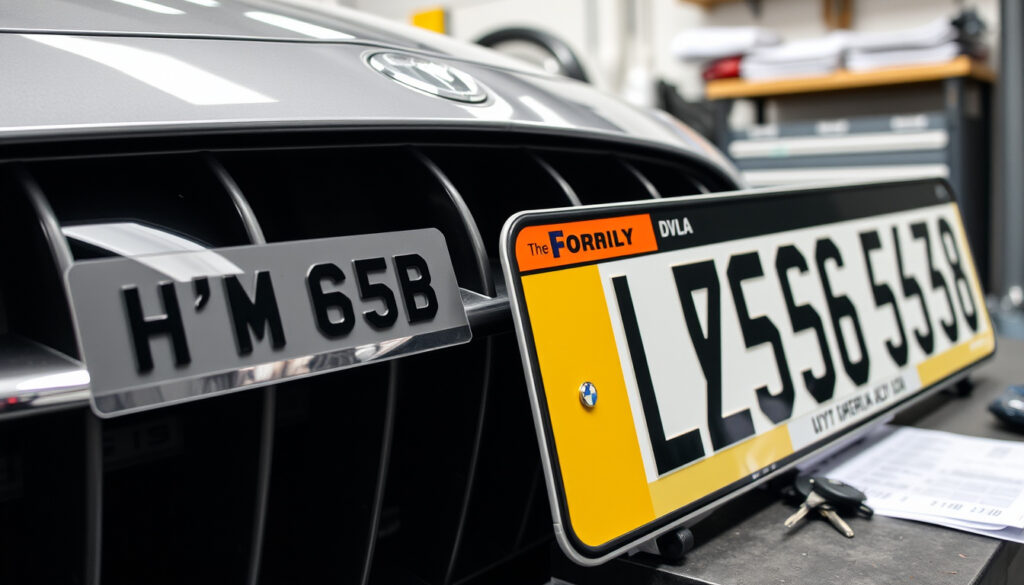
DVLA Number Plate Transfer: Guide to Assign & Switch Plates
Transferring a DVLA number plate in the UK costs £80 and requires either the V317 form by post or the online service at Gov.uk. Both methods need the V5C logbook from your vehicle, and processing typically takes 2–4 weeks before your updated registration documents arrive.
Transfer fee: £80 | Application method: Online or V317 form | Required document: V5C logbook | Keeping fee: Free online | Assign fee: Free online
Transfer Process
- V5C documents for both vehicles
- £80 fee required
- 2–4 weeks processing time
Retention First
- Free online via gov.uk
- V5C section 3 completion
- Get V750 certificate
Assignment Steps
- Online at Gov.uk
- Free to apply
- New V5C issued after approval
Key Documents
- V317 form (free from DVLA)
- V5C logbook (original)
- V750 or V778 certificate
Form V317 is used to transfer a vehicle registration number from one vehicle to another or to retain it. The fee is £80 – cheque, banker’s draft or postal order. Use form V317 to transfer a vehicle registration number from one vehicle to another.
How to transfer reg plate in the UK?
You can complete the process by putting the registration number onto the vehicle straight away or retain it on a V778 document. Online applications through Gov.uk tend to process faster than postal submissions. To begin, you will need the V5C logbook from the vehicle currently displaying the plate, along with the V5C from the vehicle receiving the plate.
Gather required documents
Both vehicles must have valid V5C logbooks for transfer. The original logbooks are required, not copies. You will also need to know the registration numbers of both vehicles, the V5C reference number (found in section 2 of the logbook), and your postcode. For transfers involving another person, both keepers sign the V317 form. If a new keeper supplement is needed, include the V62 form with your V317 application.
If your V5C is lost or damaged, apply for a replacement using form V62/7 before submitting your V317. Replacement costs £25 and adds processing time to your plate transfer.
Complete V317 application
The online transfer process starts at Gov.uk by entering the new car’s registration, current car’s registration, V5C reference, and postcode. The registered keeper fills in sections 2, 3, and 9.1; the grantee or nominee completes sections 9.1 and 9.2. If you are taxing the vehicle as part of the application, use form V10 along with your MOT certificate.
For postal V317, fill sections 1–5 under Option A for transfer to another vehicle. Option B on V317 is for retaining the plate, issuing a V778 document valid for 10 years. Payment for postal V317 is by cheque, banker’s draft or postal order to DVLA Swansea. The postal address is DVLA Personalised Registrations, Swansea SA99 1DS.
Never pay third-party websites charging you to download the V317 form. The form is free from the DVLA website, and you should avoid sites that charge for access to government documents.
Submit to DVLA
Online retention and transfer is available at www.gov.uk/keep-registration-number for £80. Submit your application and await confirmation. Include your vehicle make, model, and phone contact on the V317 checklist. Insurance certificate is required if taxing the vehicle (Northern Ireland only).
The fee is £80 – cheque, banker’s draft or postal order.
— GOV.UK, Official V317 Form
You can complete the process by putting the registration number onto the vehicle straight away or retain it on a V778 document.
— GOV.UK, Official V317 Form PDF
How long does it take to change a number plate?
Processing time for V317 is typically 2–4 weeks according to multiple sources. Online applications generally process faster than postal applications, though the exact timeline depends on DVLA workload and whether all documents are correctly submitted.
Processing timelines
Once DVLA receives and approves your V317, both vehicles receive updated V5C logbooks – the donor vehicle loses the registration number while the recipient vehicle gains it. If you have assigned the plate directly to a new vehicle, the V5C will show the new registration immediately.
The V778 document confirming your retained number arrives separately and may take up to 6 weeks total from submission to receipt. Factor this into your timeline if you need the physical retention certificate for any reason.
Factors affecting speed
Incomplete applications cause delays. Missing signatures, incorrect registration numbers, or unclear documentation will cause DVLA to return the application or request clarification. Ensure both keeper signatures are present when transferring to another person’s vehicle. Include the vehicle make, model, and contact phone number on the V317 form checklist.
What this means: Budget 4–6 weeks from application to complete receipt of all documents. Submit online if speed matters, and double-check every field before sending.
Is it free to change a number plate?
The £80 DVLA fee applies to both transfer and retention applications. Some sources suggest VAT may be added by third parties, but the official DVLA fee is £80. When using online services at Gov.uk, the application itself is handled through the £80 fee structure.
Free applications
Keeping a registration number (retention) or assigning it to a new vehicle are separate actions from the transfer fee. The retention process produces a V778 certificate valid for 10 years, renewable after expiry. Applying to keep your number is free; the £80 fee covers the transfer to a vehicle.
Paid transfers
When you transfer a plate to another vehicle, the £80 DVLA fee applies. This covers processing of the V317 form and updating both vehicle records. Payment by post must be cheque, banker’s draft or postal order made payable to DVLA Swansea.
V778 retention valid for up to 6 weeks delivery time. The certificate is valid for 10 years, after which it can be renewed.
What are the requirements for transfer of ownership?
Both vehicles must be UK registered and eligible for the transfer. The plate cannot be assigned if it would make the vehicle appear newer than its first registration date. This is a key eligibility rule enforced by DVLA.
Vehicle documents needed
You need the original V5C logbooks for both the donor and recipient vehicles. Vehicles must be taxed and have a valid MOT if required, with updated keeper details. When transferring to another person, both keepers sign the V317 form to confirm agreement.
Ownership proofs
The registered keeper must apply. A nominee process exists for V750 or V778 if the registered keeper is not making the application themselves. The grantee or nominee signs section 9.2 of the V317 form in these cases.
What this means: Ensure both vehicles have valid documentation before applying. Incomplete ownership proof or missing keeper signatures are common rejection reasons.
How to switch number plates in the UK?
The online process involves first removing the plate from your current vehicle, obtaining a reference number, then assigning it to the new vehicle. Two V317 applications are needed to swap plates between two cars.
Remove existing plate
Before applying, you must remove the current private plate from your vehicle. Obtain the reference number through the DVLA online service at www.gov.uk/keep-registration-number. This reference is required before you can assign the plate to the new vehicle.
Assign new plate
Using the gov.uk online service, enter your reference number and the new vehicle’s registration. The system will confirm eligibility and process the assignment. DVLA issues updated V5C and V778 after approval.
Vehicles must be UK registered for V317 eligibility. Both vehicles need valid V5C logbooks before you can proceed with the transfer application.
For Northern Ireland residents: include your insurance certificate when taxing the vehicle as part of the V317 application. This is a specific regional requirement not needed in England, Scotland, or Wales.
How to retain a DVLA number plate?
Select Option B on the V317 form to retain a registration number. This issues a V778 document valid for 10 years. The retention process is separate from transfer and allows you to keep the registration even without assigning it to a vehicle.
Free online retention
Keeping a registration number via the online service at www.gov.uk/keep-registration-number is free. Complete section 3 of the V5C to generate the V750 certificate, then use the gov.uk service to formalize the retention. The V778 document arrives by post and is valid for 10 years.
V750 and V778 documents
The V750 is the certificate of entitlement for assignments; the V778 is the retention certificate issued after Option B selection. Both documents serve as proof of your right to use the registration number. Retention is renewable after 10 years when the V778 expires.
What this means: Retaining a plate costs nothing and gives you 10 years to decide when to assign it to a vehicle. The V778 is your proof of ownership during this period.
How to put a private plate on a car?
Assignment steps involve using the gov.uk online service with your V778 or V750 certificate and the new vehicle’s V5C. The new vehicle’s V5C gets updated after DVLA approves the assignment. Both online keep and online assign processes are free – the £80 fee applies only to transfers.
Online assignment process
Navigate to www.gov.uk/keep-registration-number and follow the prompts to assign your retained registration to your vehicle. You will need your V778 reference number, the new vehicle’s registration, and the V5C reference from section 2 of the logbook. DVLA confirms assignment and posts the updated V5C.
After assignment
Once approved, the new vehicle’s V5C reflects the assigned registration number. Display the number plate physically on the vehicle. The previous vehicle’s V5C is simultaneously updated to remove the registration.
The registered keeper fills sections 2, 3, and 9.1 of the V317. The grantee or nominee completes sections 9.1 and 9.2 when a third party is involved in the transfer.
How to remove a private plate from a vehicle?
Removing a private plate involves either transferring it to another vehicle or retaining it on the V778 certificate. The plate must be removed from the current vehicle before the registration can be reassigned or retained.
Before removal
Confirm eligibility: the vehicle must be UK registered, and the plate cannot make the vehicle appear newer than its first registration date. Ensure you have the V5C reference number from section 2 of the logbook before proceeding.
Online removal
Use the gov.uk service to first remove the plate and obtain a reference number. This reference is then used to assign the plate to a new vehicle or retain it on the V778 certificate. Online removal is free and processed faster than postal applications.
Can I transfer a number plate online?
Yes. The online service at www.gov.uk/keep-registration-number handles both retention and transfer for £80. Online applications typically process faster than postal submissions.
Do I need both V5C documents?
Yes. Both vehicles need original V5C logbooks. The donor vehicle’s logbook shows the current registration; the recipient vehicle’s logbook receives the updated registration after transfer.
What if my vehicle has no V5C?
Apply for a replacement using form V62/7 before submitting your V317. Replacement costs £25 and adds processing time. Do not attempt the transfer without the original logbook.
How to check if a plate is transferable?
Check eligibility on the DVLA website. The plate cannot make the vehicle appear newer than its first registration date. Both vehicles must be UK registered with valid V5C logbooks.
What happens if I sell the vehicle first?
Use the retention option (Option B on V317) before selling. This keeps the registration on the V778 certificate, allowing assignment to a new vehicle later. Without retention, the plate stays with the vehicle.
Can I transfer to a new vehicle?
Yes. Use Option A for direct transfer to another vehicle, or Option B to retain then assign later. Both methods require the V5C from the receiving vehicle.
Is VAT added to the £80 fee?
The DVLA fee is £80. Third-party services may add charges, but the official DVLA processing fee is £80. Always use gov.uk for the most accurate information.
How long does the V317 process take?
Processing typically takes 2–4 weeks from submission. The V778 certificate may take up to 6 weeks total to arrive by post. Online applications generally process faster than postal.
What documents are required for V317?
Original V5C logbooks from both vehicles, the registration numbers of both vehicles, V5C reference numbers, your postcode, and £80 payment (cheque, banker’s draft, or postal order). Include V62 if adding a new keeper.
Can I swap plates between two cars?
Yes. Swapping plates between two vehicles requires two separate V317 applications. Each vehicle acts as both donor and recipient in the swap process.
What is the DVLA postal address for V317?
Send your V317 application to DVLA Personalised Registrations, Swansea SA99 1DS. Include payment by cheque, banker’s draft, or postal order made payable to DVLA.
How long is the V778 certificate valid?
The V778 retention certificate is valid for 10 years. You can renew it after expiry to continue holding the registration number without assigning it to a vehicle.
Confirmed Facts
- £80 DVLA fee applies to all transfers (GOV.UK)
- V778 valid for 10 years (Autotrader)
- Postal address: Swansea SA99 1DS (Autotrader)
- Option A transfers to another vehicle (GOV.UK PDF)
- Option B retains registration (GOV.UK)
- 2–4 weeks processing time (Absolute Reg)
- Online at www.gov.uk/keep-registration-number (GOV.UK PDF)
- Original V5C logbooks required for both vehicles (GOV.UK)
- Payment by cheque, banker’s draft, or postal order (GOV.UK PDF)
- V778 delivery up to 6 weeks (National Numbers)
What’s Unclear
- Exact processing time varies based on DVLA workload
- Third-party fees may apply beyond the £80 DVLA charge
- Scotland-specific variations beyond general UK rules
DVLA issues updated V5C and V778 after approval. The processing time for V317 is typically 2–4 weeks. Online application usually faster than post. Both vehicles must have valid V5C logbooks for transfer. Vehicles must be taxed, have valid MOT if required, and updated keeper details.
The V317 form can be downloaded for free from the DVLA website. Vehicles must be UK registered for V317 eligibility. Cannot assign plate making vehicle appear newer than first registration date. For transfer to someone else’s vehicle, both keepers sign V317. Two V317 applications needed to swap plates between two cars.
Include insurance certificate if taxing (Northern Ireland only). Replacement V5C needed if lost before V317. Retention renewable after 10 years. Payment for postal V317 by cheque, banker’s draft or postal order to DVLA Swansea.
Online process: first remove plate, get reference, then assign to new vehicle. The registered keeper must apply; nominee process for V750/V778 if not. V317 sections: registered keeper fills 2, 3, 9.1; grantee/nominee in 9.1/9.2.
Tax with V10 and MOT if taxing vehicle during transfer. Include V62 if new keeper supplement needed with V317. Provide make, model, phone contact on V317 checklist.
Related reading: Cheap Private Number Plates Under £200
dvlaform.uk, selectnumberplates.co.uk, yellowhite.co.uk, ukvehicleforms.com, webuyanycar.com, carmoney.co.uk
Budget-conscious drivers often explore cheap private number plates under £200 as a starting point before initiating DVLA transfers.
More related posts
 Susan Hampshire at 89: Forsyte Saga Return and Life Now
 Best Samsung 65 Inch TV in Ireland: Models & Reviews
 UK State Pension Age: Rise to 67, Amounts, and Key Facts
 B&Q Cribbs Causeway: Opening Times, Address, Phone & Guide
 Small Double Bed with Storage – UK Sizes and Best Options
 David Spade: Family, Career, and Kate Spade Connection
 African World Cup Qualifiers – 2026 Standings and Qualified Teams
 P and O Cruises 2024 – Winter Itineraries from Southampton