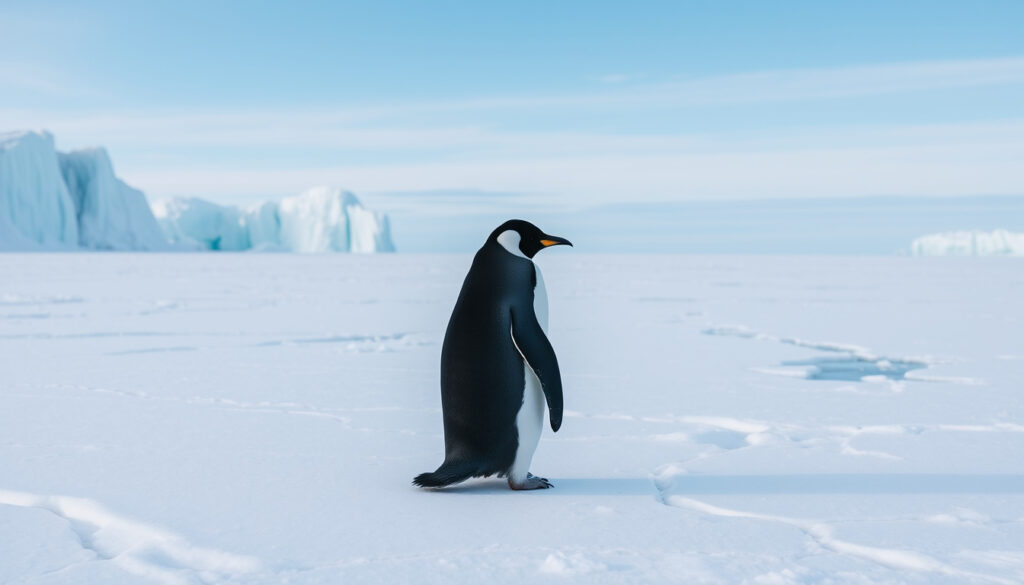
Emperor Penguin: Facts, Size, Habitat and Threats
For most animals, winter means survival mode—hunkering down, migrating, or sleeping through the cold. Emperor penguins do the opposite, marching across sea ice to breed in the heart of Antarctica’s winter, enduring temperatures as low as -60°C, making them one of the most remarkable species on the planet and also why their future is so uncertain.
Height: Up to 122 cm (48 in) ·
Weight: Up to 45 kg (99 lb) ·
Population: Approximately 238,000 breeding pairs ·
Conservation status: Near Threatened (IUCN 3.1)
Quick snapshot
- Emperor penguins are the largest living penguin species (Antarctic and Southern Ocean Coalition (conservation nonprofit))
- They breed exclusively on Antarctic sea ice (BirdLife Data Zone (scientific database))
- Male incubation lasts 64–67 days (Antarctic and Southern Ocean Coalition)
- Population is declining due to climate change (Global Penguin Society (conservation group))
- Exact number of colonies – new ones are still discovered via satellite (Antarctic Treaty System (policy document))
- Long-term impact of sea ice variability on population viability (Center for Biological Diversity (advocacy group))
- Precise mechanisms of thermoregulation in extreme cold (Nature Communications (peer-reviewed journal))
- March: Adults return to breeding colonies on sea ice (Wikipedia)
- May–June: Female lays single egg (Antarctic and Southern Ocean Coalition)
- July–August: Chicks hatch; female returns to feed (Antarctic and Southern Ocean Coalition)
- December: Chicks fledge (Nature Communications)
- Ongoing: Sea ice loss threatens breeding success (Global Penguin Society)
- Climate change may cause 80% decline by 2100 without drastic emissions cuts (Center for Biological Diversity)
- New colonies continue to be discovered via satellite imagery (Antarctic and Southern Ocean Coalition)
- Conservation status likely to be upgraded to Vulnerable if trends continue (Global Penguin Society)
The table below compiles verified data on emperor penguin dimensions and status.
| Attribute | Value | Source |
|---|---|---|
| Scientific name | Aptenodytes forsteri | Wikipedia |
| Average height | 1.1–1.3 m (3.6–4.3 ft) | Australian Antarctic Program (government research agency) |
| Average weight | 22–45 kg (49–99 lb) | Australian Antarctic Program |
| Population estimate | ~238,000 breeding pairs | Antarctic Treaty System (policy document) |
| Conservation status | Near Threatened (IUCN) | Global Penguin Society |
| Main threat | Climate change – loss of sea ice | Center for Biological Diversity |
What is special about emperor penguins?
Unique physiological adaptations
- Emperor penguins have a thick layer of blubber and dense feathers that provide insulation in temperatures below -60°C (Encyclopaedia Britannica (reference publisher)).
- They can dive to depths over 500 meters, holding their breath for up to 20 minutes (Nature Communications).
- Their haemoglobin has a high oxygen affinity, enabling extended dives under sea ice (Australian Antarctic Program).
Largest living penguin species
- Emperor penguins are the tallest and heaviest of all penguin species, reaching up to 122 cm and 45 kg (Antarctic and Southern Ocean Coalition).
- They are the only penguin species that breeds during the Antarctic winter (Antarctic and Southern Ocean Coalition).
- They live further south than any other penguin species (Antarctic and Southern Ocean Coalition).
Breeding cycle during Antarctic winter
- Females lay a single egg between May and June, then return to sea to feed (Antarctic and Southern Ocean Coalition).
- Males incubate the egg on their feet under a brood pouch for 62–67 days, fasting for up to 120 days (Antarctic and Southern Ocean Coalition).
- Chicks hatch after about 65 days and fledge in December (Nature Communications).
Males fast for up to 120 days while incubating, losing nearly half their body weight. This extreme parental investment is possible only because of the dense energy reserves they build before winter.
The implication: Emperor penguins have evolved a breeding strategy that no other bird on Earth attempts—one that is exquisitely timed to the Antarctic winter but leaves them vulnerable to even small changes in sea ice duration.
Which penguin is bigger, king or emperor?
Size and weight differences
Emperor penguins are significantly larger than king penguins across all measures. The key difference: emperor penguins are about 30 cm taller and nearly twice as heavy.
| Trait | Emperor Penguin | King Penguin |
|---|---|---|
| Average height | Up to 122 cm (48 in) | Up to 95 cm (37 in) |
| Average weight | 22–45 kg (49–99 lb) | 11–16 kg (24–35 lb) |
| Geographic range | Antarctic coast and sea ice | Sub-Antarctic islands (South Georgia, Falklands, etc.) |
| Breeding season | Winter (March–December) | Spring–summer (September–March) |
| Incubation period | 62–67 days | 54–55 days |
| Population estimate | ~238,000 breeding pairs | ~1.1 million breeding pairs |
- King penguins reach about 90 cm tall, emperor up to 122 cm (Encyclopaedia Britannica).
- King penguins breed on sub-Antarctic islands, emperor on Antarctic sea ice (Australian Antarctic Program).
- Emperor penguins are high-latitude, ice-obligate seabirds; king penguins are not tied to sea ice (BirdLife Data Zone).
The pattern: While both species are large, the emperor’s size advantage is a direct adaptation to the extreme cold and long fasting periods of the Antarctic winter. The king penguin, by contrast, lives in a milder climate and trades size for a faster breeding cycle.
Why is it called an emperor penguin?
Origin of the name
- The species was named for its regal stature as the largest penguin (Wikipedia).
- The scientific name Aptenodytes forsteri honors Johann Reinhold Forster, a naturalist on Captain Cook’s second voyage (Wikipedia).
- First described by George Robert Gray in 1844 (Encyclopaedia Britannica).
Historical discovery
- Emperor penguins were first recorded by European explorers in the early 19th century (Encyclopaedia Britannica).
- Early accounts described them as “majestic” and “emperor-like” because of their upright posture and size (Wikipedia).
The catch: The name “emperor” implies dominion, but in reality, the species is entirely dependent on the fragile sea ice that forms the base of Antarctica’s marine ecosystem—a habitat that is shrinking.
Are emperor penguins friendly?
Temperament towards humans
- Emperor penguins are generally not aggressive toward humans; they may approach out of curiosity but maintain a cautious distance (Australian Antarctic Program).
- They have no natural land predators, so they show little fear of people (Antarctic and Southern Ocean Coalition).
- However, they are not domesticated and can be stressed by close human contact (Australian Antarctic Program).
Comparison with other penguin species
- Other species like the Adelie or chinstrap penguin can be more aggressive, especially when defending nests (Encyclopaedia Britannica).
- The king penguin is also considered relatively docile compared to smaller species (Wikipedia).
Most aggressive penguin species
- The chinstrap penguin is often cited as the most aggressive, known for its territorial behavior and loud vocalizations (Encyclopaedia Britannica).
- Emperor penguins, by contrast, rarely engage in physical fights, relying on vocal displays to maintain order in large colonies (Australian Antarctic Program).
Emperor penguins may seem “friendly” because they don’t attack, but human presence can disrupt their breeding cycle. Antarctic tourism guidelines require maintaining a distance of at least 5 meters.
The pattern: The emperor penguin’s calm demeanor is not friendliness—it’s a survival strategy in a place where aggression would waste precious energy.
What is a sad fact about penguins?
Climate change threats
- Global warming is identified as a major threat because it alters sea-ice extent and duration (Global Penguin Society).
- Scientists project that 80% of the world’s emperor penguins may disappear by the end of the century without drastic cuts in carbon pollution (Center for Biological Diversity).
- Industrial fisheries can reduce prey availability, adding pressure (Center for Biological Diversity).
Sea ice loss and breeding failure
- Emperor penguins rely on stable sea ice for breeding; early breakup of ice can cause total colony failure (Nature Communications).
- Since 2016, several colonies have experienced complete breeding failure due to sea ice loss (Australian Antarctic Program).
Near Threatened status
- The IUCN lists emperor penguin as Near Threatened, with population declining (Global Penguin Society).
- Emperor penguins are considered a sentinel species for the health of the Antarctic ecosystem (BirdLife Data Zone).
The implication: The very ice that emperor penguins depend on for breeding is disappearing. If emissions continue unabated, the species could face functional extinction by 2100—a loss that would ripple through the entire Antarctic food web.
Clarity check
Confirmed facts
- Emperor penguins are the largest living penguin species (Antarctic and Southern Ocean Coalition).
- They breed exclusively on Antarctic sea ice (BirdLife Data Zone).
- Male incubation lasts 64–67 days (Antarctic and Southern Ocean Coalition).
- Population is declining due to climate change (Global Penguin Society).
What’s unclear
- Exact number of colonies – new ones are still discovered via satellite (Antarctic Treaty System).
- Long-term impact of sea ice variability on population viability (Center for Biological Diversity).
- Precise mechanisms of thermoregulation in extreme cold (Nature Communications).
- Impact of industrial fisheries on prey availability is not fully quantified (Center for Biological Diversity).
Quotes from experts
“Satellite imagery has transformed our understanding of emperor penguin distribution. We now know of about 61 colonies, and new ones are still being found.”
— Dr. Michelle LaRue, penguin ecologist, University of Canterbury (Antarctic and Southern Ocean Coalition)
“The species is listed as Near Threatened because the primary threat – climate change – is projected to cause significant population declines over the next three generations.”
— IUCN Red List assessment (Global Penguin Society)
“Emperor penguins are reliant on stable sea ice for breeding. If the ice breaks up early, the chicks cannot survive – it’s as simple as that.”
— Australian Antarctic Program researcher (Australian Antarctic Program)
The emperor penguin is a paradox: a creature that thrives in the most extreme cold on Earth, yet is entirely dependent on the very ice that is now melting. Its survival is not a biological question – it can adapt – but a political one. For the emperor penguin, the choice is stark: rapid carbon cuts, or a future where winter sea ice no longer supports their ancient breeding cycle. The next decade will decide.
quarkexpeditions.com, antarctica.gov.au, discoverwildlife.com
For a comprehensive overview of the species, including its size and the threats it faces, see this detailed guide on emperor penguin facts and conservation.
Frequently asked questions
How do emperor penguins keep warm in Antarctica?
They have a thick layer of blubber, dense feathers that trap air, and a counter-current heat exchange system in their flippers and legs. They also huddle together in large groups to conserve heat (Australian Antarctic Program).
How long can emperor penguins hold their breath?
They can hold their breath for up to 20 minutes while diving to depths over 500 meters (Nature Communications).
Do emperor penguins mate for life?
Generally, they are serially monogamous – they mate with the same partner for a breeding season, but may change partners the next year (Wikipedia).
What do emperor penguins eat?
Their diet consists mainly of fish, krill, and squid, which they catch during deep dives under sea ice (Encyclopaedia Britannica).
How fast can emperor penguins swim?
They can swim at speeds up to 8–10 km/h (5–6 mph), but can accelerate to 15 km/h when chasing prey (Australian Antarctic Program).
Where can I see emperor penguins in the wild?
Emperor penguins are found only in Antarctica. Tour operators offer expeditions to the Weddell Sea, Ross Sea, and coastal areas of East Antarctica, but sightings are rare and strictly regulated (Antarctic and Southern Ocean Coalition).
What is the difference between emperor and king penguins?
Emperor penguins are larger, breed on Antarctic sea ice in winter, and have a longer incubation period. King penguins breed on sub-Antarctic islands in spring, are smaller, and have a shorter breeding cycle (Encyclopaedia Britannica).
How many chicks do emperor penguins have per year?
They lay a single egg per year. If the chick survives to fledge, they will not breed again until the next season (Australian Antarctic Program).
More related posts
 Zara McDermott Louis Tomlinson – Relationship Timeline and Status
 Cast of Labyrinth 1986 – Full List of Actors and Puppeteers
 Ryder Cup Tee Times – 2025 Sunday Singles UK Schedule
 UK Nine-Day Snowstorm 2026: Forecast, Warnings and Impact
 Best Injection for Weight Loss: Mounjaro vs Ozempic
 Ar enal v Leed United 5-0: Match Report, Highlight , Stat
 Craig Ferguson: What Happened to the Late Night Host
 High Potential Season 2 – Release Schedule and Episode Guide