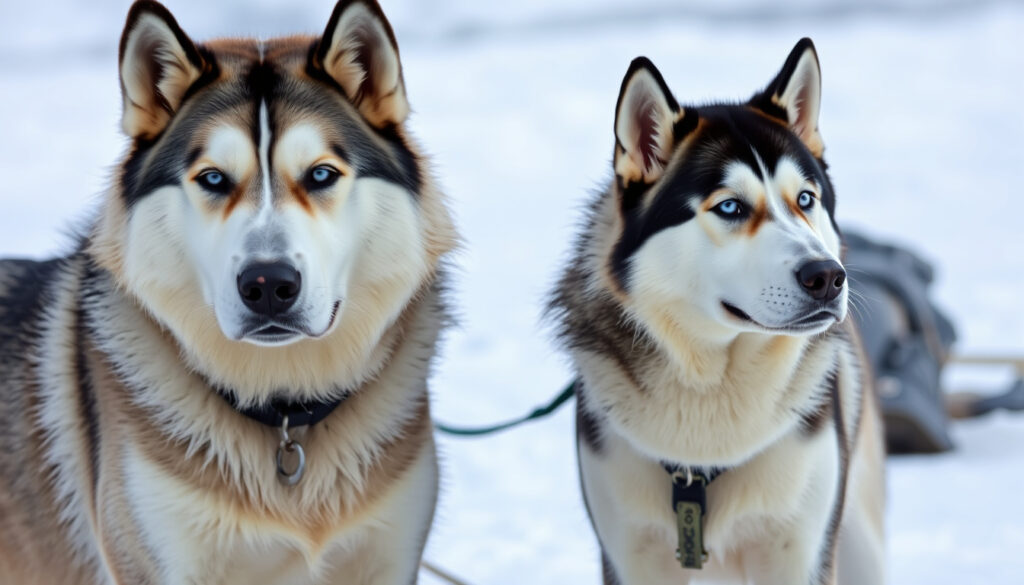
Alaskan Malamute: Temperament, Size & Husky Comparison
Ask anyone who’s owned one, and you’ll hear the same two words: powerful and stubborn. The American Kennel Club’s breed standard still frames the Malamute as a heavy freight dog — males run about 85 pounds and 85 pounds and 25 inches (AKC (official breed standard)) — and that heritage shows up everywhere from the leash to the living room. What follows separates the official facts from the individual-dog variables, and puts the Malamute head-to-head with the Siberian Husky on the questions that decide which breed actually fits your home.
Breed group: Working ·
Height: 25 in (males), 23 in (females) ·
Weight: 85 lb (males), 75 lb (females) ·
Life expectancy: 10–14 years ·
Coat: Thick double coat built for cold climates
Quick snapshot
- Males: 25 in, 85 lb; females: 23 in, 75 lb (AKC official breed standard) (Wikipedia (general reference))
- Breed standard: affectionate, loyal, playful, dignified (AKC official breed standard) (Wikipedia (general reference))
- Built to haul heavy freight, not to run sprints (Wikipedia (general reference))
- The AKC standard — the document that defines the breed — contains no bite-force metric (AKC official breed standard) (Canadian Kennel Club (national registry))
- Breed descriptions say “affectionate”; how that shows up as cuddling varies by dog (Canadian Kennel Club (national registry))
- “Aggressive dog” restrictions are local, not universal (PDSA (veterinary charity))
- Developed to haul heavy freight in Arctic conditions (Wikipedia general reference)
- Bred for strength and endurance, not speed (Wikipedia general reference)
- The modern standard still prizes a heavy, powerful build (AKC official breed standard)
- Early obedience training is non-negotiable (Encyclopaedia Britannica (general encyclopedia))
- Supervise all Malamute–child time because of size and strength (Canadian Kennel Club national registry) (Encyclopaedia Britannica (general encyclopedia))
- Judge the individual dog, not just the breed label (AKC official breed standard) (Encyclopaedia Britannica (general encyclopedia))
One list explains most of what life with a Malamute asks of you: size, coat, lifespan, temperament, and the job it was bred to do.
| Attribute | Alaskan Malamute |
|---|---|
| Breed group | Working (AKC official breed standard) |
| Height | 25 in (males), 23 in (females) (AKC official breed standard) |
| Weight | 85 lb (males), 75 lb (females) (AKC official breed standard) |
| Coat | Thick double coat; dense undercoat, coarse guard hairs (AKC official breed standard) |
| Life expectancy | 10–14 years (Purina (pet-care publisher)) |
| Temperament | Affectionate, loyal, playful, strong-willed, dignified (Canadian Kennel Club national registry) |
| Original job | Heavy freight hauling (Wikipedia general reference) |
| Children | Patient, but supervision is recommended due to size and strength (Canadian Kennel Club national registry) |
Is an Alaskan Malamute a good family dog?
Short answer: yes, for the right household, and the conditions are predictable — size, strength, will, and supervision.
The AKC standard describes the breed as “affectionate, friendly, loyal, devoted, and playful,” then adds “dignified” and notes the Malamute is “not a one-person dog” (AKC official breed standard). The Canadian Kennel Club uses similar language — “affectionate and friendly” — and adds the clause that matters most: “definitely strong-willed” (Canadian Kennel Club national registry).
Alaskan Malamute temperament
- Affectionate and loyal to their own household (AKC official breed standard)
- Playful but dignified; not a one-person dog (AKC official breed standard)
- Strong-willed and independent, which makes early obedience training especially important (Encyclopaedia Britannica general encyclopedia)
That last bullet often decides family success. A Malamute can be a wonderful family dog when training is a daily habit, not an optional class. The breed responds best to structure, exercise, and early socialization — and the dogs that struggle are usually the ones whose owners expected a softer, lighter, more eager-to-please companion.
Do Alaskan Malamutes like to cuddle?
- Breed descriptions call the Malamute affectionate and amiable with people (Encyclopaedia Britannica general encyclopedia)
- How that affection shows up depends on the individual dog and its environment (Canadian Kennel Club national registry)
- Because the breed is “not a one-person dog,” affection usually spreads across the household rather than focuses on one favorite (AKC official breed standard)
Some Malamutes plant themselves beside you for the evening; others show love on a schedule of their own. Both versions fit the breed standard’s definition of affectionate. If cuddling is a deal-breaker, meet the specific dog first — the breed label alone will not tell you which variant you’re getting.
Living with children and other pets
- Can be patient with children but should be supervised with youngsters because of size and strength (Canadian Kennel Club national registry)
- A 75–85 lb dog’s jump, pull, or accidental collision lands harder than a smaller breed’s (Canadian Kennel Club national registry)
- May be aggressive toward unfamiliar dogs, so dog-to-dog compatibility matters in multi-dog households (Encyclopaedia Britannica general encyclopedia)
None of this makes the Malamute a bad family dog; it makes it a large working dog. The supervision requirement is the same one that applies to any powerful breed, and the pattern across breed club guidance is consistent: adult management, early socialization, and clear rules.
The breed standard says “affectionate” — it also says “strong willed.” Both clauses describe the same dog: train the will and the affection has room to show up; skip the training and gets buried under 85 pounds of stubbornness (AKC official breed standard)
The pattern: the Malamute brings genuine warmth to family life, but the warmth arrives in an 85-pound package with its own agenda. Families that supervise, train, and socialize get the devoted dog the standard promises; families that skip those steps get a dog that runs the household instead.
Are Alaskan Malamutes aggressive?
This question sends people to forums at 2 a.m., so keep the breed standard and the internet lore separate.
Are Malamutes on the aggressive dog list?
- Human aggression is not a trait the AKC standard uses to describe the breed (AKC official breed standard)
- Dog aggression and dominance toward other dogs can occur, so compatibility with unfamiliar dogs is a real consideration (Encyclopaedia Britannica general encyclopedia)
- There is no universal aggressive-dog list; restrictions vary by city and country (PDSA veterinary charity)
“Aggressive dog list” is a legal term, not a breed feature. Some jurisdictions regulate or restrict specific breeds, and the lists differ from place to place — so the accurate answer to “is the Malamute on a banned list” is a local question, not a national one. On temperament, the major breed clubs describe the Malamute as affectionate toward people while flagging that unfamiliar dogs can be a different story.
Local law, not internet lore, decides whether a Malamute is restricted where you live. The AKC standard may call the breed affectionate, but a municipal ordinance can still regulate it — check your local rules (PDSA veterinary charity)
Will a Malamute protect its owner?
- Breed descriptions emphasize companionship rather than guarding duty (Canadian Kennel Club national registry)
- Size and appearance can deter an intruder, but that is presence, not trained protection (Encyclopaedia Britannica general encyclopedia)
- The Husky standard explicitly says the breed should not display guard-dog possessiveness; the Malamute standard similarly frames the breed as a companion dog (AKC Husky standard)
Malamutes are not protection dogs. They may alert to something unusual, and they may look intimidating at the door, but a dog bred to pull freight alongside people is not bred to hold a perimeter. If personal protection is the goal, a Malamute is the wrong tool — the honest read from the serious sources is companionship, not guarding.
How strong is a Malamute bite?
- No major breed club publishes a standardized bite-force measurement for the Malamute (AKC official breed standard)
- Online bite-force rankings circulate without an official testing protocol behind them (Encyclopaedia Britannica general encyclopedia)
- The documented strength is different: a breed developed to haul heavy freight (Wikipedia general reference)
The internet likes to rank bite force by breed, but the numbers from no standardized body. What sources actually document is pulling strength, not jaw pressure. The practical answer for any 85-pound working dog is the same: manage the dog so the bite never becomes relevant.
Why this matters: the aggressive Malamute reputation is a mismatch problem, not a breed verdict. The real behavioral risk — dominance with unfamiliar dogs — responds to training, and supervision, and the human-aggression story is not supported by the breed standards.
Is a Malamute bigger than a husky?
Yes — and that size gap is the single most useful fact for choosing between the two breeds.
Two breed standards tell the size story at a glance: the Malamute is the heavy freight hauler, the Husky the light traveler. The official numbers line up into a clear contrast.
| Attribute | Alaskan Malamute | Siberian Husky |
|---|---|---|
| Male height | 25 in (AKC official breed standard) | 21–23.5 in (AKC Husky standard) |
| Male weight | 85 lb (AKC official breed standard) | 45–60 lb (AKC Husky standard) |
| Female height | 23 in (AKC official breed standard) | 20–22 in (AKC Husky standard) |
| Female weight | 75 lb (AKC official breed standard) | 35–50 lb (AKC Husky standard) |
| Build | Heavy-boned, built for freighting (AKC official breed standard) | Medium-sized, quick, light-footed, graceful (AKC Husky standard) |
| Temperament | Affectionate, loyal, dignified, strong-willed (Canadian Kennel Club national registry) | Friendly, gentle, outgoing, eager (Canadian Kennel Club national registry) |
| Size limit | Standard warns size should not outweigh function (AKC official breed standard) | Disqualified above 23.5 in (males) or 22 in (females) (AKC Husky standard) |
| Child supervision | Recommended due to size and strength (Canadian Kennel Club national registry) | Friendly and gentle, but is a working dog (AKC Husky standard) |
| Attribute | Alaskan Malamute | |
| Height | 25 in (AKC official breed) | Weight | 85 lb (males), 75 lb (females) (AKC official) | Life expectancy | 10-14 |